

A clearer way to decide
Make better decisions with confidence.
Compare your options by what matters to you. See the whole picture and understand what tips the balance.







When it matters
See what makes the choice hard.
A new job, a move, a big purchase. When several options feel right for different reasons, it helps to see them side by side.
Give your priorities, risks and must-haves a place in the decision.
- Conflicting prioritiesWhat matters most when each option has strengths?
- Hidden deal-breakersCould one overlooked risk change everything?
- Too many what-ifsWhat happens if your priorities change?
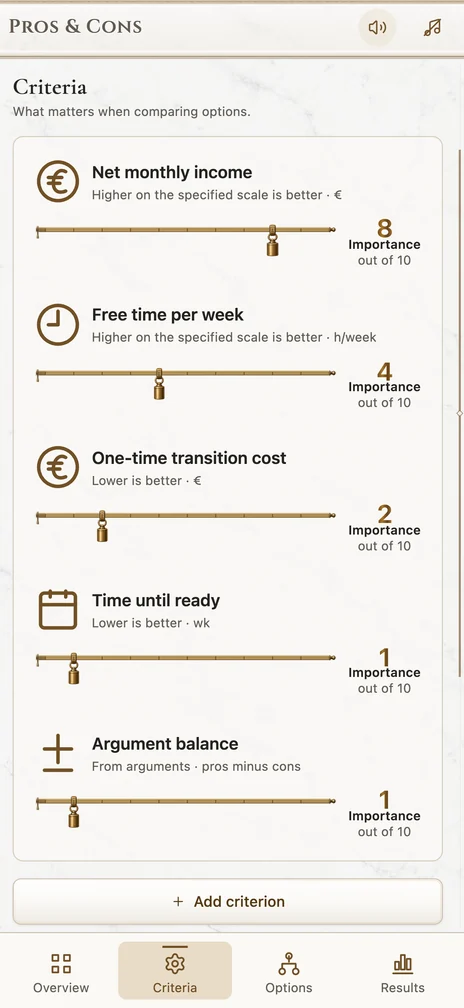
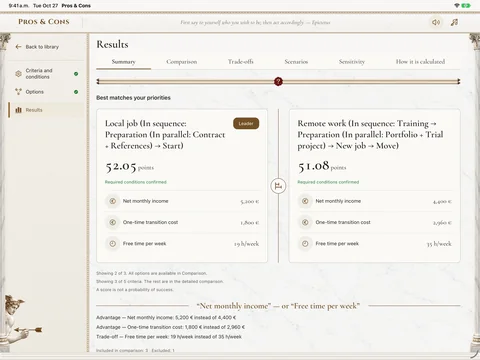

Interactive demo
A job offer in another city. Now what?
This example lets you stay, commute or move. In your own project, add more options and branch into the choices that follow.
1 Choose what matters most
5 h
Explore thousands of combinations in the app. Add your own criteria, weights and must-haves.
3 See which option fits best
The biggest edge over the next option comes from this criterion — Career growth.
Scores are for illustration.
View platformsHow it works
From a tough question to a clearer decision.
-
List your options
Start with a question and the alternatives you’re considering.
-
Set what matters
Add criteria, assign priorities, and consider risks or must-have conditions.
-
Understand the trade-offs
Compare options and see which factors drive the result.
Features
More than a pros & cons list.
Get a fuller picture of your choices and the implications of each one.
-
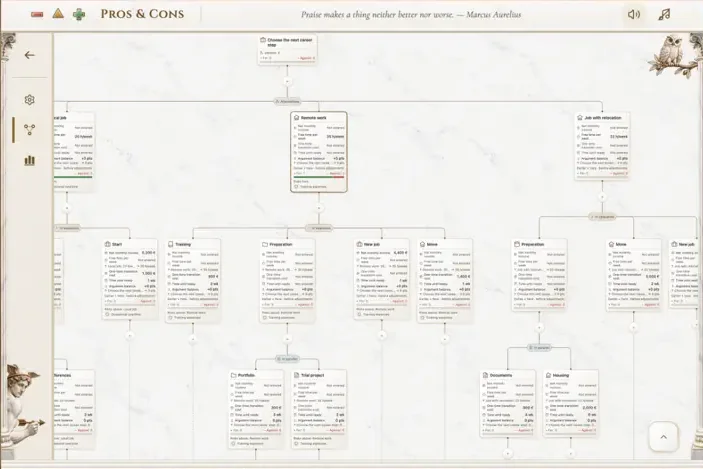
Map your options
See choices and possible next steps in a visual decision tree.
-
Weight your priorities
Give more importance to the criteria that matter to you.
-
See both sides
Capture advantages, disadvantages and meaningful trade-offs.
-
Consider risks
Include consequences and conditions an option must meet.
-
Explore what-ifs
Try different priorities and see how they affect the outcome.
-
Understand the results
See what drives the comparison and why one option leads.

Real-life decisions
Start with what matters.
Use Pros & Cons for the choices you face at work, at home, and in the years ahead.

Career
Should I accept a new job?
I worry the higher pay will come with a longer commute and later evenings.
Weigh pay, commute and time at home by your own priorities.

Moving
Is it the right time to move?
I worry moving will cost more than I expect and leave me far from my support network.
Compare moving now, moving in a year and staying. Factor in costs and support nearby.

Purchases
Which option offers better long-term value?
I worry running costs will eat up what I save on the purchase.
Compare the price, running costs and maintenance over the same period.

Projects
Where should I invest my time and energy?
Taking on everything could spread me too thin to finish anything.
Weigh impact against effort. Break each project down into steps.

Education
Which course is worth the investment?
I worry I’ll pay for a course I can’t fit into my week.
Compare the syllabus, hands-on practice and hours per week. Set a workload limit.

Lifestyle
Which routine best fits my goals?
Even a good plan can fall apart in a busy week.
Compare routines by time and effort to see what fits your actual schedule.

Housing
Closer to work or lower rent?
The lower rent could mean an extra hour of travel every day.
Compare rent, transport costs and travel time. Set a commute limit.

Travel
Where should I go on holiday?
I worry I’ll spend the holiday in transit when what I want is rest.
Compare itineraries by budget, travel time and pace.

Family
Which after-school activity should we choose?
I worry the activity will make the school week too busy.
Weigh your child’s interest, travel and schedule. Make downtime a must-have.

Business
Which supplier should I choose?
Even a week’s delay could derail the launch.
Compare prices, lead times and risks. Make the delivery deadline a must-have.

Renovation
Renovate all at once or room by room?
I worry about going over budget and disrupting home life for months.
Compare costs and timelines for both plans. Break the work into stages.

And a thousand other questions
Every decision comes with its own circumstances and doubts.
In Pros & Cons you can start with your own question, add options and decide what matters most to you.
How to compare options when the choice is hard
How do you weigh the pros and cons when the stakes are high? Pick a situation like yours and see which criteria and risks to consider in Pros & Cons.
Try the interactive demoJobs and career moves
How do you compare two job offers?
Rate pay, commute time and growth prospects. Give each factor a weight and check whether the pay increase is enough to tip the balance.
Stay on your team or move to another department?
Write down what you value about your current team, then assess the new role and its opportunities. Flag any condition the move depends on, such as keeping flexible hours.
Go freelance or stay in a salaried job?
Compare income stability, control over your schedule and time spent finding clients. Try a scenario where the first contracts arrive later than you expect.
Change careers or test a different role first?
Draw a decision tree for both paths and note what each one requires. A trial project could help you test your interest before handing in your notice.
Is a promotion worth the extra workload?
Weigh the raise, decision-making authority and time outside work. Set a must-have such as keeping evenings free for family and see whether the role meets it.
Housing and relocation
How do you decide whether to move to another city?
Compare the two cities on work, living costs and distance from family. See whether the choice changes if the household starts out on one income.
How do you choose between apartments?
Rate each place on noise, transport and total rental cost. Set a firm budget, then see which apartment meets the rest of your criteria best.
Rent or buy a home?
Compare costs over the period you expect to stay, flexibility to move and savings left after the purchase. Record your estimates and test a scenario where you need to relocate.
Stay close to the city centre or get more space?
Compare the value of the extra space with the time you would spend commuting. Check whether more days in the office change the result.
Renovate where you live or look for somewhere new?
Compare timelines, costs and disruption. Check which option solves the problem that made you consider moving in the first place.
Purchases and spending
How do you compare two cars before buying?
Enter your estimates for maintenance, safety and suitability for the trips you make most often. See how much one car’s lead depends on fuel economy.
Repair an appliance or replace it?
Weigh the repair bill, time without the appliance and the chance of it breaking down again. Compare both options again if the repair needs an extra part.
How do you choose a laptop for work and travel?
Set the performance and ports you need as requirements. Compare the models that qualify on weight, battery life and price, giving more weight to the factors you rely on every day.
Rent equipment or buy your own?
Compare costs and storage for occasional and regular use. Check how often you would need the equipment for buying to become more appealing.
Buy now or wait?
Compare what the purchase would solve today with the impact on your savings. Add an option to wait until a date when you expect to know more.
Study and professional development
How do you choose a course for a career change?
Put the courses side by side on practical work, feedback and hours per week. Give assignments more weight if building a portfolio is your priority.
Study in person or online?
Compare classroom time, travel and how easy it is to fit sessions around work. Set a realistic limit for the hours you can give each week.
Do a master’s degree or gain experience at work?
Map the roles each path could lead to. Weigh foregone income, access to relevant projects and the value of the qualification for your goal.
Prepare for an exam alone or with a tutor?
Compare flexibility, feedback and the help you can get when progress slows. Check a scenario where you have fewer hours available.
Start studying now or wait six months?
Map the steps in both plans and what has to happen before lessons start. Weigh whether the delay gives you enough time to clear your schedule or save what you need.
Projects and team decisions
Which project should you start first?
Build a decision matrix for expected impact, effort and dependencies. Weight time to launch, then check whether the order holds when long-term impact comes first.
How do you choose a supplier for a project?
Set the latest delivery date you can accept and your budget. Compare the bids that meet both requirements on quality, reliability and support.
Build your own tool or use an existing one?
Weigh time to launch, ongoing support and switching costs. Try a what-if scenario where demand grows and you need extra features.
Contract out the work or keep it in-house?
Give deadlines, cost and rework risk separate scores. Note what knowledge your team needs to keep after the project.
Launch in full or run a pilot first?
Add one branch for a full launch and another for a pilot. Note which pilot results would let you proceed and which would call for a different plan.
Family, time and daily choices
How do you choose a route for a family trip?
Compare travel time, transfers and convenient stops. If overnight travel is out of the question, make that a requirement.
How do you make time for two competing commitments?
Compare different schedules by the time left for work, rest and family. Change your weights to see which version of the week still feels manageable.
Which exercise routine fits a busy week?
Compare training at home, near work and at a local gym. Rate travel and recovery time to see which routine you could keep up.
Get a pet now or wait?
Weigh care time, available help and recurring costs. Look at a regular week and a holiday separately to see which arrangements you still need to make.
How do you choose when two options score almost the same?
Find the criterion that separates them most. Adjust its weight and, if the order changes easily, note which facts you could check before deciding.

FAQ
Before you get started.
What can I use Pros & Cons for?
Use it for personal, professional, and everyday choices with several options, from jobs and courses to purchases and long-term plans.
How does it compare my options?
You define your options, criteria, and priorities. The app compares the alternatives and shows the trade-offs behind the results.
Can I compare a decision with more than one step?
Yes. You can map alternatives as branches and compare where each path takes you. You set the criteria and assess each option.
What if an option fails a must-have?
Pros & Cons checks required conditions separately from scores and shows which conditions an option failed. Scores compare options against your priorities.
Can changing my priorities change the result?
Yes. Compare scenarios with different weights to see how your preferences affect the outcome.
Which platforms are supported?
See the Platforms section for current Pros & Cons download links.
Who makes the final decision?
You do. Pros & Cons helps you understand your options, priorities, and trade-offs so you can make your own decision.

Which decision are you putting off?
Start with one question. Compare options by your own criteria and see what could change your decision.